The Trump Economy: Feb. 15, 2025

Click here for an overview of this report, including a link to my spreadsheet.
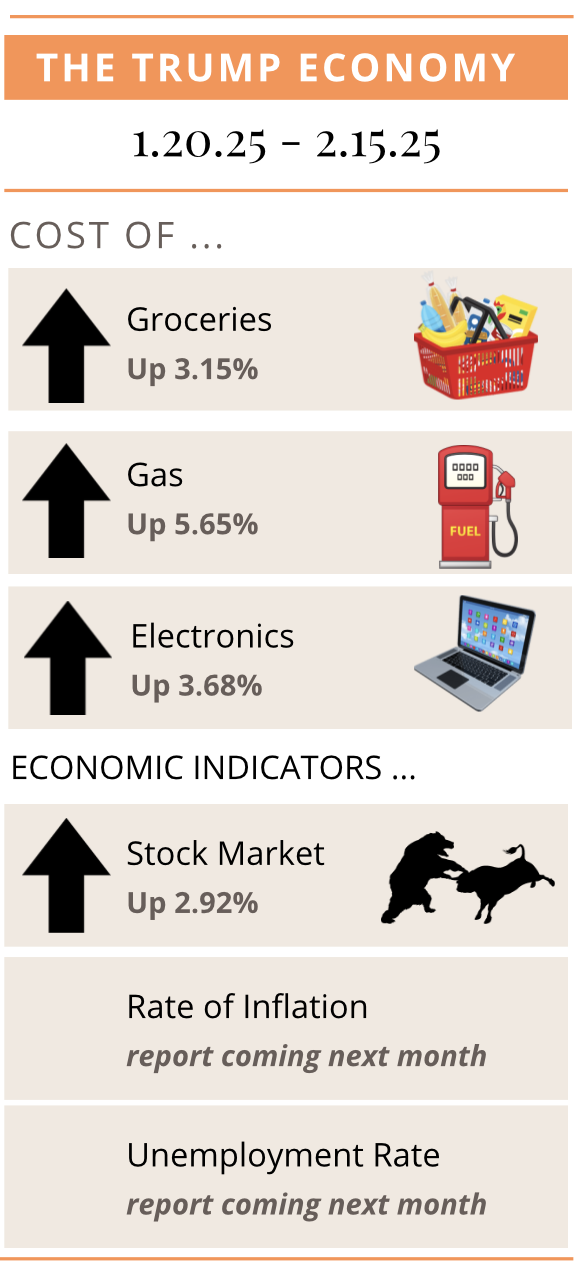
We’re roughly one month into the Trump economy, and so far he hasn’t followed through on his promises to “immediately bring prices down.” In fact, prices have gone up pretty significantly in his first full month.

My grocery cart of 22 everyday household items from Wal-Mart has increased by 3.15 percent since Trump’s inauguration, totaling $96.28 (from $93.34 in January). While one item in my shopping cart decreased in price (a 12-pack of Coca-Cola went from $7.64 to $6.86 due to a Wal-Mart sale), nine items in the cart increased from the previous month.

ItemJan. 20, 2025Feb. 15, 2025
Heinz Ketchup (20oz)$2.97$3.12
Rice Krispies (18oz)$4.98$5.23
Prego Sauce (24)$2.48$2.58
Ball Park Hot Dogs (8)$2.97$3.12
Breyer’s Ice Cream$4.67$5.14
BirdsEye Broccoli$1.97$2.77
Great Value Dozen Eggs$4.17$5.46
Great Value 2% Milk (g)$2.47$2.72
Land O Lakes Butter (4)$5.28$5.54

Fuel prices have also seen a significant increase in Trump’s first month, with the five closest stations to my Athens, Georgia residence going from an average price of $2.94/gallon to $3.11/gallon, an increase of 5.65%.

My list of eight electronics items at my local Best Buy increased by 3.68%, as the prices of a GE washer and dryer went up by $20 each (from a sale price of $679.99 to a sale price of $699.99) and an HP Chromebook increasing from a sale price of $279.99 to $399.99. This more than offset an $80 off sale on Apple AirPods 2.

Two metrics that were positive in Trump’s first month were the stock market (up 2.92%) and my home value (up 0.22%).

My 401(k) rate of return, the US inflation rate and the unemployment rate all report a month behind, so those will be reported next month.

The Trump Economy: Breakdown

“When I win, I will immediately bring prices down, starting on day one,” Donald Trump said in an August press conference, also vowing to slash gas prices by 50%.

Trump’s economic promises likely gave him the boost needed to win the election, as Americans have been hit hard by inflation, which increased year-over-year by 5.2% over Biden’s tenure.

How is President Trump doing on his promises to “bring prices down?” From his first day in office (1/20/25) and the 15th of every month, I will keep track of my cart of 22 grocery items from my local Walmart. The items range from household essentials (toilet paper, paper towels, dish soap) to popular food items (milk, eggs, chicken).

I’m tracking eight popular electronics items from my local Best Buy, including a GE top-loading washer and dryer, a Samsung 55-inch smart TV, an HP Chromebook and Apple AirPods.

I’m tracking fuel prices from the five closest gas stations to my home, as well as my 401(k) monthly rate of return (from Fidelity) and my home value (from Zillow).

I will also list the major stock market closing numbers (S&P 500, Nasdaq and Dow Jones Industrial Average) on the 15th of every month (or the closest day to it if the market is closed), the monthly unemployment rate and the monthly rate of inflation. The latter two reports are the only federal government data I am using for this analysis.

I don’t pretend to think this reporting technique is comprehensive or “scientific.” The grocery, electronics and fuel prices represent prices in Athens, Georgia. The home value and 401(k) reports are from my personal accounts. But that’s exactly what makes this reporting unique. Instead of relying on abstract national data produced by the government, the goal of this reporting is to see the impact (positive or negative) of the Trump presidency on the economy from a real, personal standpoint.

My spreadsheet of prices will also be publicly available through Google Sheets. I also have screenshots of all prices, which I will publish as soon as I find an appropriate way to display them.