The Trump Economy: Feb. 15, 2025

Click here for an overview of this report, including a link to my spreadsheet.
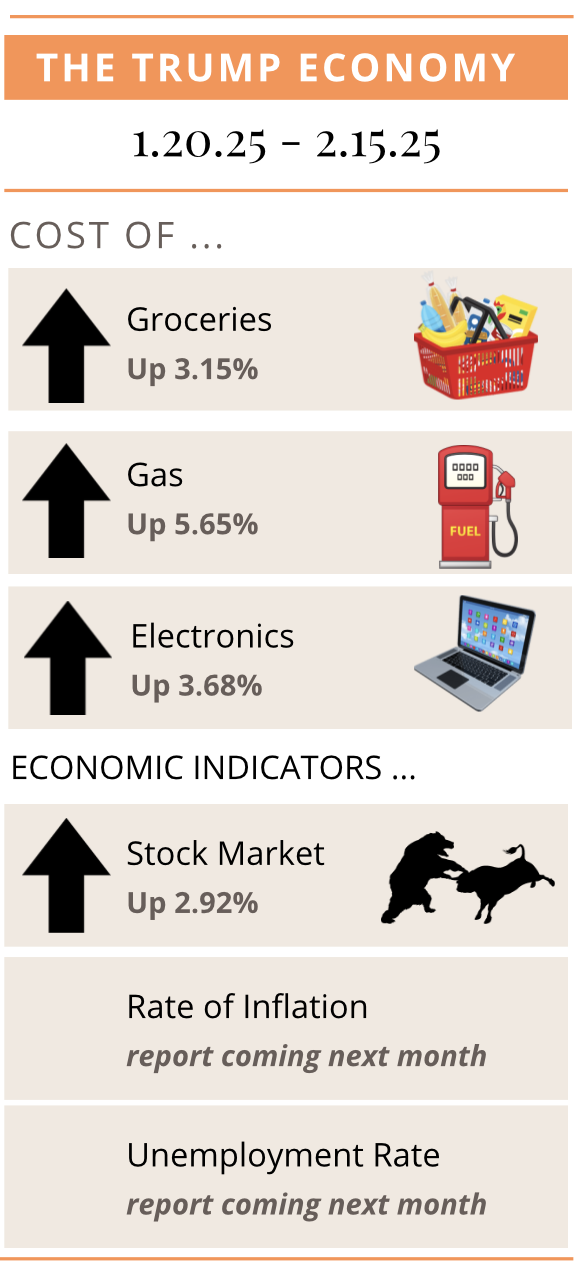
We’re roughly one month into the Trump economy, and so far he hasn’t followed through on his promises to “immediately bring prices down.” In fact, prices have gone up pretty significantly in his first full month.

My grocery cart of 22 everyday household items from Wal-Mart has increased by 3.15 percent since Trump’s inauguration, totaling $96.28 (from $93.34 in January). While one item in my shopping cart decreased in price (a 12-pack of Coca-Cola went from $7.64 to $6.86 due to a Wal-Mart sale), nine items in the cart increased from the previous month.

ItemJan. 20, 2025Feb. 15, 2025
Heinz Ketchup (20oz)$2.97$3.12
Rice Krispies (18oz)$4.98$5.23
Prego Sauce (24)$2.48$2.58
Ball Park Hot Dogs (8)$2.97$3.12
Breyer’s Ice Cream$4.67$5.14
BirdsEye Broccoli$1.97$2.77
Great Value Dozen Eggs$4.17$5.46
Great Value 2% Milk (g)$2.47$2.72
Land O Lakes Butter (4)$5.28$5.54

Fuel prices have also seen a significant increase in Trump’s first month, with the five closest stations to my Athens, Georgia residence going from an average price of $2.94/gallon to $3.11/gallon, an increase of 5.65%.

My list of eight electronics items at my local Best Buy increased by 3.68%, as the prices of a GE washer and dryer went up by $20 each (from a sale price of $679.99 to a sale price of $699.99) and an HP Chromebook increasing from a sale price of $279.99 to $399.99. This more than offset an $80 off sale on Apple AirPods 2.

Two metrics that were positive in Trump’s first month were the stock market (up 2.92%) and my home value (up 0.22%).

My 401(k) rate of return, the US inflation rate and the unemployment rate all report a month behind, so those will be reported next month.

The Trump Economy: Breakdown

“When I win, I will immediately bring prices down, starting on day one,” Donald Trump said in an August press conference, also vowing to slash gas prices by 50%.

Trump’s economic promises likely gave him the boost needed to win the election, as Americans have been hit hard by inflation, which increased year-over-year by 5.2% over Biden’s tenure.

How is President Trump doing on his promises to “bring prices down?” From his first day in office (1/20/25) and the 15th of every month, I will keep track of my cart of 22 grocery items from my local Walmart. The items range from household essentials (toilet paper, paper towels, dish soap) to popular food items (milk, eggs, chicken).

I’m tracking eight popular electronics items from my local Best Buy, including a GE top-loading washer and dryer, a Samsung 55-inch smart TV, an HP Chromebook and Apple AirPods.

I’m tracking fuel prices from the five closest gas stations to my home, as well as my 401(k) monthly rate of return (from Fidelity) and my home value (from Zillow).

I will also list the major stock market closing numbers (S&P 500, Nasdaq and Dow Jones Industrial Average) on the 15th of every month (or the closest day to it if the market is closed), the monthly unemployment rate and the monthly rate of inflation. The latter two reports are the only federal government data I am using for this analysis.

I don’t pretend to think this reporting technique is comprehensive or “scientific.” The grocery, electronics and fuel prices represent prices in Athens, Georgia. The home value and 401(k) reports are from my personal accounts. But that’s exactly what makes this reporting unique. Instead of relying on abstract national data produced by the government, the goal of this reporting is to see the impact (positive or negative) of the Trump presidency on the economy from a real, personal standpoint.

My spreadsheet of prices will also be publicly available through Google Sheets. I also have screenshots of all prices, which I will publish as soon as I find an appropriate way to display them.

Democracy and Doughnuts

Like millions of Americans, I woke up today distraught to learn the election results. 

After briefly absorbing the news, my first thought was, “Maybe I should get doughnuts this morning.”

I promised my 60 students I would get them doughnuts if we attained 70% completion on academic adviser evaluations. They missed the mark by nine points. Done deal. No doughnuts. You snooze. You lose.

However, I knew several of my students would be hurting this morning, feeling hopeless after the election. Maybe I should get them doughnuts anyway? Perhaps just mini doughnuts? Or maybe some doughnut holes? But then a random text came through from a former student — an alum with whom I haven’t chatted in several months — “You better get your students doughnuts today.” 

It was settled. Doughnuts it is — full-size doughnuts. To be sure, I stopped at both Dunkin and Krispy Kreme. Six dozen doughnuts total (or “donuts” if they’re the Dunkin variety). It was the right call. Students immediately converged on my office, grabbing a donut and sharing their feelings. At one point seven students crowded into my office, expressing their fears, venting their frustrations, airing out their anger and cracking jokes about their impending doom.

I dismiss the notion that politics aren’t personal. If you were eavesdropping on my office this morning you’d hear an undocumented student fearing deportation, a gay student worried about losing their right to marry, a student anxious that her special-needs brother would lose his government assistance. These are all very legit concerns based on the future President’s agenda, and they are highly personal issues to these students.

But the country voted. And the majority voted for a candidate whose policies, if enacted, will definitely impact these students. I can’t do anything about that. But as these seven were gathered in my office, I realized in that moment I could be the most important person in their lives. I can listen. I can hug. I can emphathize. I can show them that they matter, regardless of where they were born, who they love or the color of their skin. 

By demonstrating Christlike love, I can have a direct impact on the people around me, regardless of the hate surrounding them.  Of course that doesn’t mean I’m stopping my fight against sexism, racism, nativism and heterosexism — that will be especially important in the years to come. But for now the best thing I can do for those feeling hopeless is to create a safe environment for them, and let them know I genuinely care.

And maybe occasionally, provide them doughnuts.

Another school shooting … and I feel nothing

When news of the Apalachee school shooting happened yesterday, I felt nothing. I checked to make sure none of my contacts worked at the school and checked in on a friend who graduated from there, but the sad truth is that I didn’t feel emotion.

Even though the school is just 30 minutes from my home, and I’ve been on that campus several times, and I know several people who went to Apalachee, I was emotionless. And it’s not that I’m an unemotional person — I cried during Sandy Hook. I cried during Parkland. I cried during Vegas.

But now, I’m just numb. 

School shootings in America are like fatal car accidents — for those directly involved, it’s unexpected, it’s tragic, it’s devastating. For everyone else, there may be a fleeting moment of sadness, some “thoughts and prayers,” but then it’s back to normal until the next tragedy.

In America, more children die as a result of gun violence than from any other cause, including vehicle accidents and health issues. We are the only wealthy country in the world that has this epidemic, but instead of doing something about it, our leaders wear it like a badge of honor. 

Two-thirds of the Supreme Court possess an incredibly broad interpretation of the 2nd Amendment … so much so that they even overturned President Trump’s sensible ban on bump stocks. Members of the Republican Party are so afraid of the NRA that they won’t even consider proposals that even a majority of Republican voters support, like raising the minimum age to purchase a gun or requiring mental health background checks for gun ownership. And we have politicians — including the governor of Georgia — who continuously downplay the seriousness of guns by using them as props in campaign commercials.

Over the next few days, pundits will be quick to blame first-person shooter video games or violence in movies (like the summer’s top movie, Deadpool vs. Wolverine) while ignoring the real problem. Although such fictional works may play some role in normalizing guns in society, it’s a reality that we as Americans accept real gun violence. Other first-world countries share our affection for fictional violence, but only in America do we replicate that violence. The correlation couldn’t be clearer — those other countries have sensible laws preventing their citizens from owning weapons of mass destruction. America does not. And when people point this out, we’re chastised by some for making this political.

But the Apalachee school shooting was political. Because policy could’ve made it preventable. Uvalde was preventable. Parkland was preventable.

Canada, France, Germany, Australia, the United Kingdom — and every other first-world nation — has demonstrated that school shootings are preventable. Until a certain segment of the population decides to value life over guns, we will continue to add more children to the list of preventable deaths when another school shooting happens. 

And when the next school shooting happens, we’ll go through the same steps of confirming to see if anyone we know was impacted, perhaps have a moment of sadness, and offer our “thoughts and prayers” before going about our day. But if we’re being honest, that rote pattern repeated after every preventable tragedy is on par with the same emotion I will likely feel again — nothing.

Who’s to blame for the mess in Afghanistan? Mostly, you and me.

Republicans (and some Democrats) are blaming Biden. Democrats are blaming Trump. The truth is we all — including you and me — share blame for the brutal Taliban takeover of Afghanistan.

https://unsplash.com/@sohaibghyasi

Here’s the facts:

  1. Biden inherited a horrible deal the Trump administration made with the Taliban in which we agreed to pull out all our troops by summer 2021. With that said …
  2. Biden did not need to honor that deal. He’s the U.S. President now. He’s reversed several other Trump policies (as Trump did with Obama’s Iran deal), and could’ve done so on this one.
  3. Biden decided to honor the deal and pull out of Afghanistan, a decision supported by Trump, the majority of Congress and 73% of Americans at the time. It was a bold decision after 20 years of the status quo. However …
  4. Biden completely botched the American withdrawal. And his explanations to us have been horrible, casting the blame to Trump. The world is watching, and the U.S. looks really bad and unreliable.
  5. The Taliban not only has power and will undoubtedly return to its inhumane treatment of its citizens (especially women), but also billions of dollars of military equipment that the U.S. gave to Afghanistan.
  6. Russia has already assisted the Taliban fight the previous Afghan regime, and they will likely become allies now. China likely will, too. This will be a huge problem for the U.S.
  7. Trump, Biden and 73% of Americans — including myself — were wrong about Afghanistan. For the future protection of our own country, the U.S. should not have pulled out of Afghanistan. Unfortunately …
  8. We can’t turn back time. However, our country owes asylum to the Afghan people who helped the U.S. over the years. Not only should we maintain control of the airport, but troops should enter Kabul and rescue the dissidents, who will most likely be executed by the Taliban.
  9. This horrendous situation is not just the fault of the Biden and Trump administrations. They were both acting on the will of their constituents (remember that 73% of Americans wanted troops pulled out). It’s our fault. It’s one of the few issues that united us. The overwhelming majority of Americans, including myself, did not bother to educate ourselves on the nuances of the Afghanistan situation. We saw things in black and white. We were ignorant. But how could we have known? …
  10. The media (broad term) failed as well. Our news media is so focused on conflict and immediacy with “click-bait” headlines so stories can be shared easily on social media feeds. There’s no room for nuance. Our politicians have adapted to this, and if something can’t be explained in a headline, a 10-second soundbite or a funny meme, then it’s not a point worth arguing. Americans have rewarded this type of “journalism” with clicks and views. Our social media-driven short attention spans can’t handle more. Shame on us.

Afghanistan is Biden’s fault. And Trump’s fault. And the media’s fault. But ultimately it’s our ignorance that allowed this to happen.